White Shaker Cabinets as a Neutral Base
Neutral is not the same as invisible. A White Shaker door works as a base because the profile is old enough to read as background and the color is light enough to let the floor, the stone and the hardware carry the date. CasaBuilt lists the six-cabinet starter kitchen in White Shaker at $1,199.50, which is $31.19 below the same bundle in Navy Blue and $14.57 above Hudson Grey.
Key takeaways
- White Shaker is the middle of the painted range on price: $1,199.50 against $1,184.93 in Hudson Grey and $1,230.69 in Navy Blue.
- The profile, not the color, is what has stayed in use; a plain frame and panel reads as background in almost any room.
- Neutrality is a design decision with a cost: the four chart styles span $963.35 for the same six cabinets.
- Five of the 14 color-tagged sample doors are white, so the pale end of the range is the easiest to test.
Why the profile outlives the color
A shaker door is a frame, a recessed panel and nothing else. No bead, no applied molding, no arch. That plainness is why it survives redecorating: there is no decorative detail to date, so the door stops competing with whatever is in front of it. A raised-panel door announces a period. A flat slab announces a decade. A frame and panel mostly stays quiet.
CasaBuilt cuts the door as a rubberwood frame with an MDF panel, and the collection lists eleven Shaker styles, from White through Hudson Grey, Navy Blue, Espresso and Iron Black. The style count matters because it shows the profile is a platform rather than a single look. The same geometry is offered in enough colors that a buyer can choose the neutral without changing the cabinet.
A White Shaker kitchen also accepts hardware changes better than most. Swap brass for matte black and the room reads differently without a single door coming off. That is the cheapest way to move a kitchen through a trend, and it only works when the door itself is plain enough to let the metal speak.
White is a range, not a color
The catalogues treat white as a family. The sample page tags five of its 14 color-counted doors as white, alongside three gray, two brown and one each of black, beige, green and navy. Within the Shaker line the names run from White Shaker to Double Dove White and Slim Dove White, and those are not the same white. Undertone decides whether a door looks warm beside a wood floor or cold beside a gray stone.
That is why the white shaker door should be judged against the surfaces it will sit next to, not against a screen. Hold the sample against the floor at the doorway, then against the counter edge, then against the wall paint. A white that looks creamy alone can look pink beside a cool gray top, and a white that looks crisp alone can look blue beside a warm oak floor.
The lighting in the room does the rest. North light makes white read cooler, west light makes it warmer at the end of the day, and a single pendant over an island adds a pool of warmth that no swatch photograph can show. Buyers who skip the sample stage usually end up choosing the white that looked best on a monitor rather than the one that looks best at seven in the evening.
What neutrality costs, and what it saves
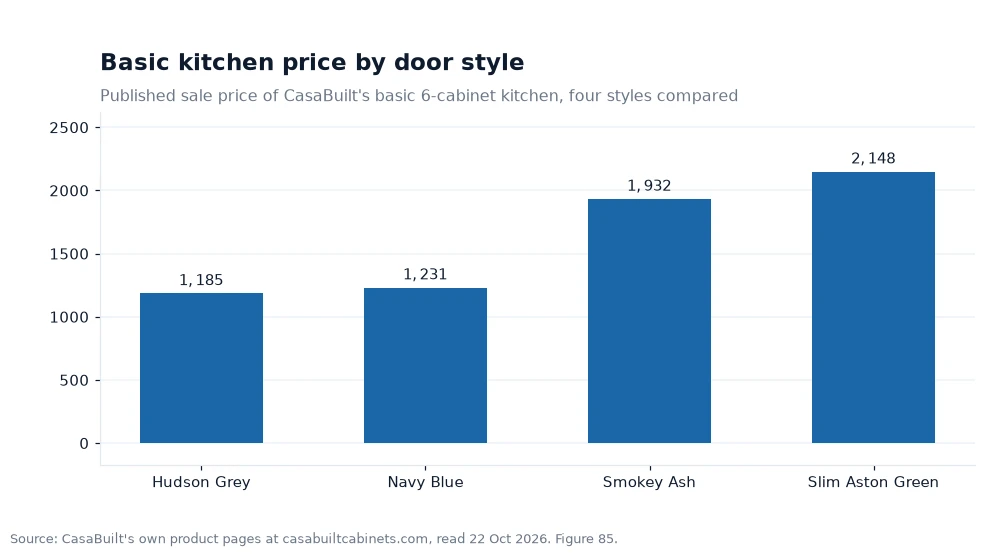
White sits near the bottom of the painted price range, which is part of why it stays popular. The basic bundle is two base cabinets, two wall cabinets, one tall cabinet and one vanity, and the published sale prices put the white door at $1,199.50 against a $2,399.00 list. The colored styles in the chart sit on either side of it.
| Style | Sale price | List price | Discount | Difference vs White Shaker |
|---|---|---|---|---|
| Hudson Grey Shaker | $1,184.93 | $2,369.86 | 50% | -$14.57 |
| White Shaker | $1,199.50 | $2,399.00 | 50% | $0.00 |
| Navy Blue Shaker | $1,230.69 | $2,461.37 | 50% | +$31.19 |
| Smokey Ash Shaker | $1,932.42 | $2,415.52 | 20% | +$732.92 |
| Slim Aston Green Shaker | $2,148.28 | $2,685.36 | 20% | +$948.78 |
The three painted 50%-off styles sit inside a $45.76 band, from $1,184.93 to $1,230.69, so choosing white over gray or navy is a color decision worth less than a faucet. The two 20%-off styles are a different purchase entirely: the discount is shallower, the door construction is the slim profile, and the price step is measured in hundreds rather than tens.
Where a white base stops working
White fails in rooms that give it nothing to sit against. An all-white kitchen with white walls, white stone and white floor has no edge, and the result reads as a rental refresh rather than a design. The door needs one warm surface and one dark surface to look intentional: a wood floor, a stone with visible movement, a dark island, a black window frame, a run of open shelving in oak.
It also fails under neglect more visibly than a mid-tone. Grease, fingerprints and scuffs all show on a pale door, and the areas that collect them are predictable: around pulls, along the bottom rail, beside the range. A weekly wipe keeps the run even; a year of skipped cleaning turns the high-touch doors a shade warmer than the ones nobody opens.
Finally, white is not a shortcut for a bad layout. A pale door cannot rescue a run of cabinets that stops short of the ceiling or a hood that floats without a bridge above it. The neutral simply makes those gaps easier to see, because there is no busy grain or strong color to distract from the geometry.
Worked example: where white sits in the chart
The chart quotes Hudson Grey at $1,184.93, Navy Blue at $1,230.69, Smokey Ash at $1,932.42 and Slim Aston Green at $2,148.28. The spread across the four is $2,148.28 minus $1,184.93, which equals $963.35 for the same six cabinets. Divide that by six and the range is $160.56 per cabinet.
Now place the white bundle, published at $1,199.50, inside that spread. It is $1,199.50 minus $1,184.93, or $14.57, above Hudson Grey. It is $1,230.69 minus $1,199.50, or $31.19, below Navy Blue. So white sits in the bottom 5% of the $963.35 range: $14.57 divided by $963.35 is 1.5%.
The top of the range is a different scale. $2,148.28 divided by $1,184.93 is 1.81, so the dearest style costs 81% more than the cheapest. The white bundle divided by six is $199.92 per cabinet, and $1,199.50 divided by $2,399.00 is exactly 0.50, matching the published 50% discount. For scale, $963.35 divided by $9.99 is 96.4, so the full spread is worth about 96 sample doors.
Frequently asked questions
Is White Shaker a trend that will date?
The frame-and-panel profile has been in continuous production long enough to read as background, and white is the most common neutral in the range. What dates a white kitchen is usually the surrounding detail, such as a heavy arch, a colored backsplash or an all-white scheme with no contrast, rather than the door itself.
Does a white door show dirt more than a dark one?
It shows grease and fingerprints more, and it hides dust less. The trade is manageable: wipe the pull area and the bottom rail weekly, and clean the doors above the range before the film sets. A dark door hides smudges but shows dust and chips more clearly.
Can I change the look later without replacing the doors?
Hardware is the cheapest change, and a plain frame-and-panel door takes a new pull or knob without looking mismatched. The published hinges are concealed and six-way adjustable, so doors can be rehung and realigned after the swap rather than replaced.
Build the room around the white
If the layout is still open, CasaBuilt's free design service turns measurements into a 3D plan in 24-48 hours. Choose the white last, not first. Pick the floor, the counter and one wood tone, then order two or three pale samples and hold them against those surfaces at different times of day. The right white is the one that stays quiet beside all three, not the one that looks brightest on its own.
Then spend the difference where it shows. The step from white to the top of the chart is $948.78 for the same six cabinets, which is real money in a kitchen; a better faucet, a deeper sink or a second-hand island will change the room more than a darker door will.
Figures quoted here come from the manufacturer's own website, read 22 Oct 2026[1].